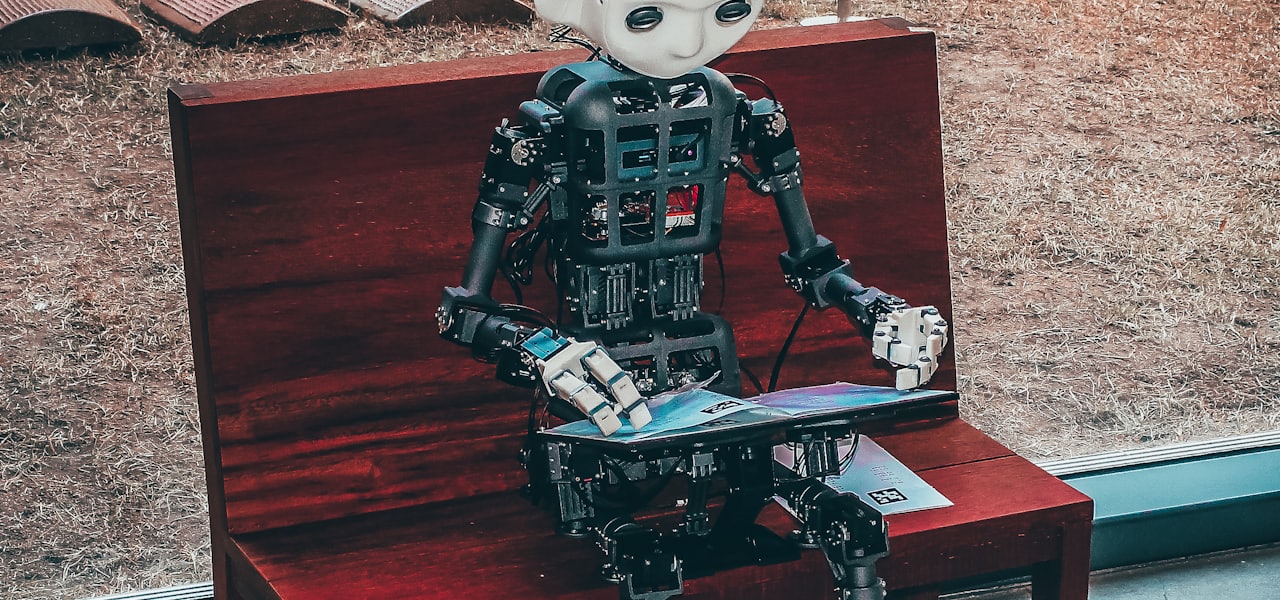
Language technology, often called human language technology (HLT), studies methods of how computer programs or electronic devices can analyze, produce, modify or respond to human texts and speech. Working with language technology often requires broad knowledge not only about linguistics but also about computer science. It consists of natural language processing (NLP) and computational linguistics (CL) on the one hand, many application oriented aspects of these, and more low-level aspects such as encoding and speech technology on the other hand. Note that these elementary aspects are normally not considered to be within the scope of related terms such as natural language processing and (applied) computational linguistics, which are otherwise near-synonyms. As an example, for many of the world's lesser known languages, the foundation of language technology is providing communities with fonts and keyboard setups so their languages can be written on computers or mobile devices. Other tools also are part of modern language technology and include machine translation, speech recognition, text processing and natural language processing. Large scale AI models have recently advanced the field and enhanced the ability of machines to interpret complex human context.
Visual Turing Test
The Visual Turing Test is “an operator-assisted device that produces a stochastic sequence of binary questions from a given test image”. The query engine produces a sequence of questions that have unpredictable answers given the history of questions. The test is only about vision and does not require any natural language processing. The job of the human operator is to provide the correct answer to the question or reject it as ambiguous. The query generator produces questions such that they follow a “natural story line”, similar to what humans do when they look at a picture. == History == Research in computer vision dates back to the 1960s when Seymour Papert first attempted to solve the problem. This unsuccessful attempt was referred to as the Summer Vision Project. The reason why it was not successful was because computer vision is more complicated than what people think. The complexity is in alignment with the human visual system. Roughly 50% of the human brain is devoted in processing vision, which indicates that it is a difficult problem. Later there were attempts to solve the problems with models inspired by the human brain. Perceptrons by Frank Rosenblatt, which is a form of the neural networks, was one of the first such approaches. These simple neural networks could not live up to their expectations and had certain limitations due to which they were not considered in future research. Later with the availability of the hardware and some processing power the research shifted to image processing which involves pixel-level operations, like finding edges, de-noising images or applying filters to name a few. There was some great progress in this field but the problem of vision which was to make the machines understand the images was still not being addressed. During this time the neural networks also resurfaced as it was shown that the limitations of the perceptrons can be overcome by Multi-layer perceptrons. Also in the early 1990s convolutional neural networks were born which showed great results on digit recognition but did not scale up well on harder problems. The late 1990s and early 2000s saw the birth of modern computer vision. One of the reasons this happened was due to the availability of key, feature extraction and representation algorithms. Features along with the already present machine learning algorithms were used to detect, localise and segment objects in Images. While all these advancements were being made, the community felt the need to have standardised datasets and evaluation metrics so the performances can be compared. This led to the emergence of challenges like the Pascal VOC challenge and the ImageNet challenge. The availability of standard evaluation metrics and the open challenges gave directions to the research. Better algorithms were introduced for specific tasks like object detection and classification. Visual Turing Test aims to give a new direction to the computer vision research which would lead to the introduction of systems that will be one step closer to understanding images the way humans do. == Current evaluation practices == A large number of datasets have been annotated and generalised to benchmark performances of difference classes of algorithms to assess different vision tasks (e.g., object detection/recognition) on some image domain (e.g., scene images). One of the most famous datasets in computer vision is ImageNet which is used to assess the problem of object level Image classification. ImageNet is one of the largest annotated datasets available and has over one million images. The other important vision task is object detection and localisation which refers to detecting the object instance in the image and providing the bounding box coordinates around the object instance or segmenting the object. The most popular dataset for this task is the Pascal dataset. Similarly there are other datasets for specific tasks like the H3D dataset for human pose detection, Core dataset to evaluate the quality of detected object attributes such as colour, orientation, and activity. Having these standard datasets has helped the vision community to come up with well performing algorithms for all these tasks. The next logical step is to create a larger task encompassing of these smaller subtasks. Having such a task would lead to building systems that would understand images, as understanding images would inherently involve detecting objects, localising them and segmenting them. == Details == The Visual Turing Test (VTT) unlike the Turing test has a query engine system which interrogates a computer vision system in the presence of a human co-ordinator. It is a system that generates a random sequence of binary questions specific to the test image, such that the answer to any question k is unpredictable given the true answers to the previous k − 1 questions (also known as history of questions). The test happens in the presence of a human operator who serves two main purposes: removing the ambiguous questions and providing the correct answers to the unambiguous questions. Given an Image infinite possible binary questions can be asked and a lot of them are bound to be ambiguous. These questions if generated by the query engine are removed by the human moderator and instead the query engine generates another question such that the answer to it is unpredictable given the history of the questions. The aim of the Visual Turing Test is to evaluate the Image understanding of a computer system, and an important part of image understanding is the story line of the image. When humans look at an image, they do not think that there is a car at ‘x’ pixels from the left and ‘y’ pixels from the top, but instead they look at it as a story, for e.g. they might think that there is a car parked on the road, a person is exiting the car and heading towards a building. The most important elements of the story line are the objects and so to extract any story line from an image the first and the most important task is to instantiate the objects in it, and that is what the query engine does. === Query engine === The query engine is the core of the Visual Turing Test and it comprises two main parts : Vocabulary and Questions ==== Vocabulary ==== Vocabulary is a set of words that represent the elements of the images. This vocabulary when used with appropriate grammar leads to a set of questions. The grammar is defined in the next section in a way that it leads to a space of binary questions. The vocabulary V {\displaystyle {\mathcal {V}}} consist of three components: Types of Objects T {\displaystyle {\mathcal {T}}} Type-dependent attributes of objects A ( t ) {\displaystyle {\mathcal {A}}(t)} Type-dependent relationships between two objects R ( t , t ′ ) {\displaystyle {\mathcal {R}}(t,t')} For Images of urban street scenes the types of objects include people, vehicle and buildings. Attributes refer to the properties of these objects, for e.g. female, child, wearing a hat or carrying something, for people and moving, parked, stopped, one tire visible or two tires visible for vehicles. Relationships between each pair of object classes can be either “ordered” or “unordered”. The unordered relationships may include talking, walking together and the ordered relationships include taller, closer to the camera, occluding, being occluded etc. Additionally all of this vocabulary is used in context of rectangular image regions w \in W which allow for the localisation of objects in the image. An extremely large number of such regions are possible and this complicates the problem, so for this test, regions at specific scales are only used which include 1/16 the size of image, 1/4 the size of image, 1/2 the size of image or larger. ==== Questions ==== The question space is composed of four types of questions: Existence questions: The aim of the existence questions is to find new objects in the image that have not been uniquely identified previously. They are of the form : Qexist = 'Is there an instance of an object of type t with attributes A partially visible in region w that was not previously instantiated?' Uniqueness questions: A uniqueness question tries to uniquely identify an object to instantiate it. Quniq = 'Is there a unique instance of an object of type t with attributes A partially visible in region w that was not previously instantiated?' The uniqueness questions along with the existence questions form the instantiation questions. As mentioned earlier instantiating objects leads to other interesting questions and eventually a story line. Uniqueness questions follow the existence questions and a positive answer to it leads to instantiation of an object. Attribute questions: An attribute question tries to find more about the object once it has been instantiated. Such questions can query about a single attribute, conjunction of two attributes or disjunction of two attributes. Qatt(ot) = {'Does object ot have attribute a?' , 'Does object
Language-Theoretic Security
Language-theoretic security, or LangSec, is an approach to software security that focuses on input handling, complexity, and program design as strategies to improve the verifiability of computer programs. It was introduced in 2005 by Robert J. Hansen and Meredith L. Patterson at BlackHat and in 2011 by Len Sassaman and Patterson. It aims to create a formal description of which software is likely to have security vulnerabilities of particular classes, and why. It considers programs to have an inherent parser component, whether or not explicit, composed of that part of the program which operates on external input before that input is fully parsed. A central hypothesis of language-theoretic security is that vulnerabilities in software increase according to the computational power of the notional input-accepting automaton equivalent to this parser, using the definitions of automata theory. The lower bound on this computational power is the input language complexity of the program. The extent to which reducing this complexity is possible is a function of the specification of the communication protocol or file format the program takes as input. == Parsing as a security mechanism == The behaviour of a program is defined with reference to its expected input. Unexpected input being used by a program is a factor in numerous security bugs, including the so-called Android master key vulnerability (CVE-2013-4787), because accepting unexpected input renders the program's specification ambiguous. In that instance, the unexpected ambiguity came in the form of a ZIP file with duplicate filenames. If a program fully parses its input and only acts on input that unambiguously meets the specification, it follows that the program will avoid these types of vulnerabilities. This is an intentional inversion of the Postel principle. Accepting only unambiguous and valid input is a more formal requirement than input validation or sanitization, and narrows the number of possible but unanticipated program states that can be induced in an application via user input. Conversely, failure to do this is associated with security vulnerabilities. Input sanitization in particular is held to be an inadequate approach to avoiding malicious input because it inherently ignores context-sensitive properties of the input; it can therefore result in paradoxical effects, such as sanitization code activating otherwise inert cross-site scripting payloads in browsers. === Parser differentials === If the language of accepted program input is sufficiently simple, it is possible to verify that two implementations parse the same input language consistently. This is advantageous because it shows no parser differential exists between the two implementations. The requisite level of simplicity is theoretically that for which there is a solution to the equivalence problem. If the two parsers involved in CVE-2013-4787 were equivalent - that is, if they rendered the same output state given the same input state - the vulnerability could not have existed. One strategy for doing this is to publish machine-readable specifications of a format or protocol, and then use a parser generator to generate the parser code. An example of a parser generator built for this purpose is DaeDaLus. The combination of Lex with any of GNU Bison, ANTLR, or Yacc also accomplishes this. However, many parser generators allow the mixing of general purpose code with the parsing definitions, which weakens the guarantees provided by parsing. === Analysis of injection attacks === Injection attacks are generally the result of differences between the serializer (or "unparser") and the corresponding parser at a layer boundary in a system; therefore, they are a special case of parser differentials. In a SQL injection attack, for example, an attacker is able to cause the application with which they are interacting to serialize a SQL query that has different semantics than intended. In the simplest case where the payload ends a string and adds new code, the payload has crossed the code-data boundary in SQL. In language-theoretic security, this is treated as a bug in the serializer of the SQL query, which should instead be written in a way that constrains its possible outputs to those within the scope of the intended query. === Parser combinators === If a parser generator is not used, it is still possible to avoid implementation bugs by using parser combinator such as Nom to implement the parser code. This has the drawback of relying on a programmer correctly translating the specification into the language of the parser generator library, though this task is still less error-prone than hand-coding a parser. == Input format complexity == Complexity in computer programs is associated with security vulnerabilities. Within the domain of language-theoretic security, complexity is described with reference to the computational power of the abstract machine necessary to implement the program, or more particularly, to implement the parser for its input language. This complexity describes whether it is possible to show that there is no unintended or undesired functionality in the program which might be exploitable by an attacker. To be bounded in complexity, the program's input must be well-defined both in terms of form and of semantics. === Weird machines === A weird machine is a model of computation in a program that exists in parallel with, but is distinct from, the intended abstract model of computation in that program. Some classes of weird machine arise from the multi-layered nature of computer programs, or the context in which the programs run; others result from the unanticipated functionality a program has due to its complexity or to software bugs. The more complex the computation model of a program, the more likely it is to implement a weird machine. Depending on context, the weird machine may or may not be concretely useful for an attacker. Since the space of weird machines in the context of some program is the universe of all possible states that are not within the program's intended states, many exploited states including remote code execution and injection attacks belong to the domain of weird machines. A reduction in weird machines is therefore a likely correlate with reduced program vulnerability. === SafeDocs project === SafeDocs is a DARPA project undertaken in 2018 to take existing file formats, create safer subsets of them, and develop programming tools to work for the safer formats. The initial test case for this was PDF. The purpose of creating safer subsets in this case is to lower the minimum bound on parser complexity so that it becomes possible to create tools that will generate correct, normative parsers for them. == Relation to programming languages == The analytic framework of language-theoretic security assumes programs to be virtual machines that execute their input. A document that is read by an application is in this sense a form of machine code, in a generalization of the data as code idea, following the automata theory description of parsers. === Type-safe programming languages === Parsing input and serializing output are operations that consume one data type and emit another. A programming language can therefore check that data is correctly parsed and contains the expected structure by checking data types, and correct serializing (or unparsing) can be implemented as operations on the data types that are relevant to the program's output. This approach can be used to show that the recognizer and unparser patterns have been implemented. It is also possible to implement type checking across a distributed system to enforce parsing and unparsing of the expected structures and to verify that the assumptions made in designing the compositional properties of a distributed system have been followed. === Memory-safe programming languages === In the general case, spatial memory correctness is undecidable. If any proof of spatial memory correctness is to be made, it is therefore necessary to bound the complexity of the code. Interpreted languages such as Java and Python effectively accomplish this via runtime bounds checking, and frameworks for runtime bounds checking also exist for C. The effect of these strategies for spatial memory correctness are to create a halt state in place of a spatial memory correctness violation; therefore, it can be shown that the program will not violate spatial memory correctness, but in exchange, it cannot be shown in the general case that programs will not have runtime bounds checking exceptions. Some programming languages, such as Rust, accomplish this using borrow checking. The borrow checker acts to assure spatial memory correctness by compile-time reference counting. Code for which spatial memory correctness cannot be shown to not be violated therefore does not compile, inherently limiting the complexity of the spatial memory correctness of the program to what is decidable. Thi
Per-pixel lighting
In computer graphics, per-pixel lighting refers to any technique for lighting an image or scene that calculates illumination for each pixel on a rendered image. This is in contrast to other popular methods of lighting such as vertex lighting, which calculates illumination at each vertex of a 3D model and then interpolates the resulting values over the model's faces to calculate the final per-pixel color values. Per-pixel lighting is commonly used with techniques, such as blending, alpha blending, alpha to coverage, anti-aliasing, texture filtering, clipping, hidden-surface determination, Z-buffering, stencil buffering, shading, mipmapping, normal mapping, bump mapping, displacement mapping, parallax mapping, shadow mapping, specular mapping, shadow volumes, high-dynamic-range rendering, ambient occlusion (screen space ambient occlusion, screen space directional occlusion, ray-traced ambient occlusion), ray tracing, global illumination, and tessellation. Each of these techniques provides some additional data about the surface being lit or the scene and light sources that contributes to the final look and feel of the surface. Most modern video game engines implement lighting using per-pixel techniques instead of vertex lighting to achieve increased detail and realism. The id Tech 4 engine, used to develop such games as Brink and Doom 3, was one of the first game engines to implement a completely per-pixel shading engine. All versions of the CryENGINE, Frostbite Engine, and Unreal Engine, among others, also implement per-pixel shading techniques. Deferred shading is a recent development in per-pixel lighting notable for its use in the Frostbite Engine and Battlefield 3. Deferred shading techniques are capable of rendering potentially large numbers of small lights inexpensively (other per-pixel lighting approaches require full-screen calculations for each light in a scene, regardless of size). == History == While only recently have personal computers and video hardware become powerful enough to perform full per-pixel shading in real-time applications such as games, many of the core concepts used in per-pixel lighting models have existed for decades. Frank Crow published a paper describing the theory of shadow volumes in 1977. This technique uses the stencil buffer to specify areas of the screen that correspond to surfaces that lie in a "shadow volume", or a shape representing a volume of space eclipsed from a light source by some object. These shadowed areas are typically shaded after the scene is rendered to buffers by storing shadowed areas with the stencil buffer. Jim Blinn first introduced the idea of normal mapping in a 1978 SIGGRAPH paper. Blinn pointed out that the earlier idea of unlit texture mapping proposed by Edwin Catmull was unrealistic for simulating rough surfaces. Instead of mapping a texture onto an object to simulate roughness, Blinn proposed a method of calculating the degree of lighting a point on a surface should receive based on an established "perturbation" of the normals across the surface. == Hardware rendering == Real-time applications, such as video games, usually implement per-pixel lighting through the use of pixel shaders, allowing the GPU hardware to process the effect. The scene to be rendered is first rasterized onto a number of buffers storing different types of data to be used in rendering the scene, such as depth, normal direction, and diffuse color. Then, the data is passed into a shader and used to compute the final appearance of the scene, pixel-by-pixel. Deferred shading is a per-pixel shading technique that has recently become feasible for games. With deferred shading, a "g-buffer" is used to store all terms needed to shade a final scene on the pixel level. The format of this data varies from application to application depending on the desired effect, and can include normal data, positional data, specular data, diffuse data, emissive maps and albedo, among others. Using multiple render targets, all of this data can be rendered to the g-buffer with a single pass, and a shader can calculate the final color of each pixel based on the data from the g-buffer in a final "deferred pass". Because deferred shading assumes only one visible fragment per pixel sample, transparent objects are generally handled in a separate forward pass. == Software rendering == Per-pixel lighting is also performed in software on many high-end commercial rendering applications which typically do not render at interactive framerates. This is called offline rendering or software rendering. NVidia's mental ray rendering software, which is integrated with such suites as Autodesk's Softimage is a well-known example.
Variable data publishing
Variable-data publishing (VDP) (also known as database publishing) is a term referring to the output of a variable composition system. While these systems can produce both electronically viewable and hard-copy (print) output, the "variable-data publishing" term today often distinguishes output destined for electronic viewing, rather than that which is destined for hard-copy print (e.g. variable data printing). Essentially the same techniques are employed to perform variable-data publishing, as those utilized with variable data printing. The difference is in the interpretation for output. While variable-data printing may be interpreted to produce various print streams or page-description files (e.g. AFP/IPDS, PostScript, PCL), variable-data publishing produces electronically viewable files, most commonly seen in the forms of PDF, HTML, or XML. Variable-data composition involves the use of data to conditionally: exhibit text (static blocks and/or variable content) exhibit images select fonts select colors format page layouts & flows Variable-data may be as simple as an address block or salutation. However, it can be any or all of the document's textual content—including words, sentences, paragraphs, pages, or the entire document. In other words, it can make up as little or as much of the document as the composer desires. Variable data may also be used to exhibit various images, such as logos, products, or membership photos. Further, variable-data can be used to build rule-based design schemes, including fonts, colors, and page formats. The possibilities are vast. The variable-data tools available today, make it possible to perform variable-data composition at nearly every stage of document production. However, the level of control that can be achieved varies, based upon how far into the document production process a variable-data tool is deployed. For example, if variable-data insertion occurs just prior to output...it's not likely that the text flow or layout can be altered with nearly as much control as would be available at the time of initial document composition. Many organizations will produce multiple forms of output (aka: multi-channel output), for the same document. This ensures that the published content is available to recipients via any form of access method they might require. When multi-channel output is utilized, integrity between those output channels often becomes important. Variable-data publishing may be performed on everything from a personal computer to a mainframe system. However, the speed and practical output volumes which can be achieved are directly affected by the computer power utilized. == Origin of the concept == The term variable-data publishing was likely an offshoot of the term "variable-data printing", first introduced to the printing industry by Frank Romano, Professor Emeritus, School of Print Media, at the College of Imaging Arts and Sciences at Rochester Institute of Technology. However, the concept of merging static document elements and variable document elements predates the term and has seen various implementations ranging from simple desktop 'mail merge', to complex mainframe applications in the financial and banking industry. In the past, the term VDP has been most closely associated with digital printing machines. However, in the past 3 years the application of this technology has spread to web pages, emails, and mobile messaging.
ARIS Express
ARIS Express is a free-of-charge modeling tool for business process analysis and management. It supports different modeling notations such as BPMN 2, Event-driven Process Chains (EPC), Organizational charts, process landscapes, whiteboards, etc. ARIS Express was initially developed by IDS Scheer, which was bought by Software AG in December 2010. The tool is provided as freeware on the ARIS Community webpage. ARIS Express is notable - having been mentioned in research published by Schumm, Garcia, Krumnow and Greenwood amongst others. == History == ARIS Express was first announced on April 28, 2009 in a press release by IDS Scheer. The first release was on July 28, 2009 in a public beta test on ARIS Community. Only people, who registered before for the beta test were allowed to download and test this beta version. This closed beta test was followed with another public beta test. The official release of ARIS Express 1.0 was on September 9, 2009. In this first stable version, features such as Microsoft Visio import were added, which were not present in the version for the public beta test. On February 26, 2010, ARIS Express 2.0 was released. Major changes compared to version 1.0 include BPMN 2 support, integrated spellchecking and ARISalign integration. On May 25, 2010, version 2.1 of ARIS Express was released. This update improves BPMN 2 support, provides a new online help system for instant feedback, better ARISalign integration and some new symbols in different diagrams. Along with the release, a poster showing the most important modeling concepts supported by ARIS Express was released. In addition, an executable setup is provided for Microsoft Windows-based systems. Beginning of July, an update was released as ARIS Express 2.2, providing bug fixes only. ARIS Express version 2.2 is the current stable release. An official press release published mid of August 2010 said there are more than 50,000 downloads of ARIS Express. On February 2, 2011, version 2.3 of ARIS Express was released. This new version changes the file format of ARIS Express so that models can be shown in an interactive model viewer in ARIS Community. The release announcement contained no details about additional features or changes. == Functionality == === Overview === ARIS Express is a standalone single-user application. It is divided in a home screen and a modeling environment. The home screen is used to create new models or open recently edited ones. The modeling environment is used to edit diagrams. === Supported notations === The following notations are supported by ARIS Express. Users can create diagrams containing an unlimited number of modeling objects. BPMN 2 Collaboration Diagrams Event-driven Process Chains (EPC) Organizational charts Process landscape (value-added chain diagram) Data model in ERM notation IT infrastructure (network diagram) System landscape (component diagram) Whiteboard General diagram === Noteworthy features === Besides common features such as creating new diagrams, saving them as files or adding objects to the modeling canvas, ARIS Express also provides some noteworthy features, which can't be found in most comparable modeling tools. fragments - Often used modeling constructs such as an exclusive decision in a process model can be stored as fragments so that they are available for direct reuse in another model. smart designs - The flow of a process model or hierarchies of other models can be captured in a spreadsheet-like interface. While entering the data in the spreadsheet, the model is generated and laid out in the background while typing. mini toolbar - While moving the mouse pointer over an object in a diagram, a small toolbar is shown allowing quick access to the most important modeling actions. Microsoft Visio import - Diagrams created with Microsoft Visio 2007 or above can be imported to and edited in ARIS Express. A Microsoft Visio export is not provided. ARISalign import - Models created on the online collaboration platform ARISalign can be opened and edited in ARIS Express. === Exports === ARIS Express can export diagrams to different formats such as: PDF JPEG PNG EMF ADF ADF is the file format of ARIS Express. The professional tools of ARIS Platform are able to import diagrams stored in the ADF format. Yet, there are major limitations during import - namely, each object in diagram will be treated as unique object, despite having same type and name, forcing redrawing large sections of diagrams after import. Besides export formats, it is also possible to use the clipboard to copy and paste an ARIS Express diagram into typical office suites such as Microsoft PowerPoint. == Technology == ARIS Express is a Java-based application, which shares some of the features of ARIS Platform products such as ARIS Business Architect and ARIS Business Designer. In contrast to ARIS Platform products, ARIS Express doesn't use a central database for model storage. Instead, each diagram is stored in an ADF file. ARIS Express uses Java Web Start. After download, the application can be started immediately without installation procedure. For Microsoft Windows based systems, an ordinary setup is provided, too. ARIS Express requires Java 1.6.10 or above. On first startup, the user must enter a valid ARIS Community account to register the application. Creating an ARIS Community account is free-of-charge. After installation, no Internet connection is needed to use ARIS Express. ARIS Express uses a mechanism provided by Java Web Start to automatically update the application as soon as a new version becomes available and the user is connected to the Internet during startup. There are reports that this automated update failed while upgrading from version 1.0 to version 2.0. As ARIS Express is based on Java Web Start, it can be installed on any platform supported by Java. The ARIS Community and other Internet sources have reports of successful deployment of ARIS Express on other operating systems than Microsoft Windows. However, ARIS Express is officially supported only on Microsoft Windows. == Miscellaneous == A quick reference sheet is available for ARIS Express. The poster shows all supported diagrams plus the most important modelling concepts for each supported modelling language. ARIS Express contains a hidden game, a so-called Easter Egg. The game can be started by clicking several times on the product logo in the about dialog. Highscores achieved in the game can be submitted to a special page in ARIS Community. A Firefox Personas is available for ARIS Express.
Joseph Stanislaus Ostoja-Kotkowski
Joseph Stanislaus Ostoja-Kotkowski AM, FRSA (also known as J. S. Ostoja-Kotkowski, Ostoja and Stan Ostoja-Kotkowski; 28 December 1922 – 2 April 1994) was best known for his ground-breaking work in chromasonics, laser kinetics and 'sound and image' productions. He earned recognition in Australia and overseas for his pioneering work in laser sound and image technology. His work included painting (instrumental in developing geometric art in Australia), photography, film-making, theatre design, fabric design, murals, kinetic and static sculpture, stained glass, vitreous enamel murals, op-collages, computer graphics, and laser art. Ostoja flourished between 1940 and 1994. Ostoja's films are still being exhibited. == Biography == Joseph Stanislaus Ostoja-Kotkowski was born in Golub, Poland, on 28 December 1922, descending from an old noble family that was part of the Clan of Ostoja. He studied drawing under Olgierd Vetesco in Przasnysz from 1940-1945. After winning a scholarship, he completed his studies at the Düsseldorf Academy of Fine Arts in Germany in 1949. In 1950 Ostoja migrated to Australia, arriving in Melbourne where he supported himself with work as a labourer. He enrolled at the Victorian School of Fine Arts National Gallery School under Alan Sumner and William Dargie 1950-1955 and there introduced the new abstract expression of Europe both to lecturers and students. He settled in the Adelaide Hills, South Australia, on the Booth estate at Stirling, living under the patronage of the Booth family for over 40 years (Freya Booth, the wife of Edward Stirling Booth, was a daughter of the artist Sir Hans Heysen). His first one-man exhibition was also in South Australia at the Royal Society of Arts, Adelaide. In 1956 Ostoja met and collaborated with Ian Davidson in the production of the short film Five South Australian Artists, and became involved in stage and theatre set design. He co-produced several experimental films again with Ian Davidson, including The Quest of Time in 1957 Ostoja's work in abstract expression began to receive accolades. He won the Cornell Prize for the canvas Form in Landscape. He started to design sets for theatre and dance including for Six Characters in Search of an Author by Luigi Pirandello (1957); the South Australian production of Samuel Beckett's Waiting for Godot (1958); Gaetano Donizetti's Elixir of Love, with novel light settings and modulations, for the Elder Conservatorium of the University of Adelaide which used his techniques for their Opera Workshops (1959); for The Egg; and for two performances of the South Australian Ballet Theatre with light/colour abstract presentations (1959). 1960 This year he designed sets for a new opera group which would eventually grow into the South Australian Opera Company. Among other theatrical events, he designed and executed the scenery for Moon on a Rainbow Shawl by Errol John, and The Teahouse of the August Moon by John Patrick, (a production by the University of Adelaide Theatre Guild). He received artistic satisfaction but little financial reward for these efforts. In this year also, he staged a visual production on the theme of Orpheus, using dance, music and voice with several projectors. This was the first attempt at quadraphonic sound in Australia, working in collaboration with Derek Jolly, who provided the sound and projection equipment. It was also the first demonstration of "Chromasonics" - the science of translating sound into visual images. Ostoja then designed innovative "abstracted" scenery for a production of The Marriage of Figaro and Benjamin Britten's The Turn of the Screw. 1961 Ostoja designed the sets for the controversial South Australian production of Patrick White's The Ham Funeral - also Alan Seymour's Swamp Creatures, both performed by the University of Adelaide Theatre Guild. He designed and constructed six stained glass windows for the Refectory at the University of Adelaide. In this period Ostoja designed special lights and gauzes for difficult effects required in an ambitious production of the opera Don Carlos by the Opera Workshop, for the Elder Conservatorium. 1962 Ostoja designed and built sets for the production of J.B, by Archibald MacLeish, for the second Adelaide Festival of Arts. He exhibited vitreous enamel works in Melbourne's Argus Gallery. Max Harris, in The Bulletin of 20 October 1962, praised Ostoja's sets for My Cousin from Fiji in Union Theatre, Adelaide, and his technique of rear screen projections as later adopted throughout Australia. 1963 Ostoja continued to develop Multi-Image projections, demonstrating for the first time in Australia the concept later to be known as 'audio-visuals!'. Ostoja gave Sir Herbert Read, the art critic, a personal viewing of one of his visual presentations. At Christmas, in the Elder Conservatorium, collaborating again with Derek Jolly, Ostoja gave what was probably the world's first "visual concert", using special projectors and incorporating music, colours and shapes. 1964 With fellow Adelaide artist John Dallwitz, Ostoja co-designed the first of several experimental dance and stage productions in the Adelaide Festival of Arts Sound and Image. The production featured Adelaide dancer Elizabeth_Cameron_Dalman. Also for the Adelaide Festival of Arts of that year, he designed the largest light mosaic ever staged up to that time, upon the facade of an 11-storey building. Ostoja was invited to New Zealand, and exhibited the first electronically generated images in Australia in Melbourne, at the Argus Gallery. His design for the 50-foot (15 m) bas-relief mural for the new B.P. building in Melbourne was the subject of a film which won the "Blue Ribbon" Award in the American Film Festival in New York. 1965 Ostoja designed and made the first light kinetic mural in Australia, and continued to evolve theatrical works using multi-screen and Multi-projector techniques. The Production of Jean Genet's The Balcony was very controversial. With Elizabeth Dalman, Ostoja produced new dance forms for Melbourne Television. He introduced Op Art to Australia, both at South Yarra Gallery in Melbourne, and Gallery A in Sydney. 1966 With John Dallwitz, Ostoja was invited by the Adelaide Festival of Arts to present more experimental theatre, Sound and image 1966. This highly acclaimed production incorporated Australian poetry into the sound, electronic music, and visual images and featured the dancer Antonio Rodrigues. The architect Robin Boyd commissioned Ostoja to design two large Op murals for the Australian Pavilion entrance at the Expo 67. Ostoja was awarded a Churchill Fellowship, which enabled him to have extensive world travel, comparing art and technology in many countries. He began to work with language, contemporary poetry and prose, and computers. 1967 John Dallwitz and Ostoja presented Sound and Image at the Festival of Perth. In Berne, Switzerland, Ostoja received the "Excellence F.I.A.P." Award for innovative photography. 1968 At the Adelaide Festival of Arts, Ostoja and John Dallwitz collaborated again to stage Sound and Image. This was the first theatre production in the world to use a laser beam. It also included the first science fiction play (The Veldt by Ray Bradbury) performed in Australia. Ostoja's theatre methods were increasingly attracting the attention of critics to how plays were staged. "Chromasonics", developed and introduced by Ostoja, was now being used extensively in the entertainment industry. 1969 Ostoja staged Krzysztof Penderecki's St. Luke Passion, a controversial, contemporary religious work. The South Australian The Advertiser wrote an extensive critique of Ostoja's work. Robin Boyd commissioned Ostoja to build a "Chromasonic" exhibit located in the Space Tube at the Australian Pavilion for Expo '70 in Osaka. 1970 Ostoja presented an Australian Aboriginal Dreamtime theme in his "Sound and Image" theatre, working with leading contemporary figures in poetry, music and dance. This was the first production of its kind in Australia, and appeared after the Festival in Melbourne, Sydney, Canberra and Perth. Ostoja's Space Scape mural, sixty feet long by ten feet high, won the Australia-wide competition for a mural for Adelaide Airport. His 120 feet (37 m) high 'light and sound' structure for the Adelaide Festival was the first of its kind in the world. 1971 Ostoja awarded a Creative Arts Fellowship at the Australian National University, Canberra. His 18-month stay resulted in the design and building of a "Chromasonics unit-laser", a 100 feet (30 m) Chromasonic tower, and a world premiere of a Synchronos concert. 1972 With Don Burrows and Don Banks, Ostoja presented Synchronos 72, where one could "hear the colours and see the sounds". Ostoja added Cymatics, developed during the Fellowship, to his workshop repertoire. He was invited to exhibit his photography in the National Gallery, Melbourne. 1973 Ostoja received a Fellowship from the Australian American Education Associatio